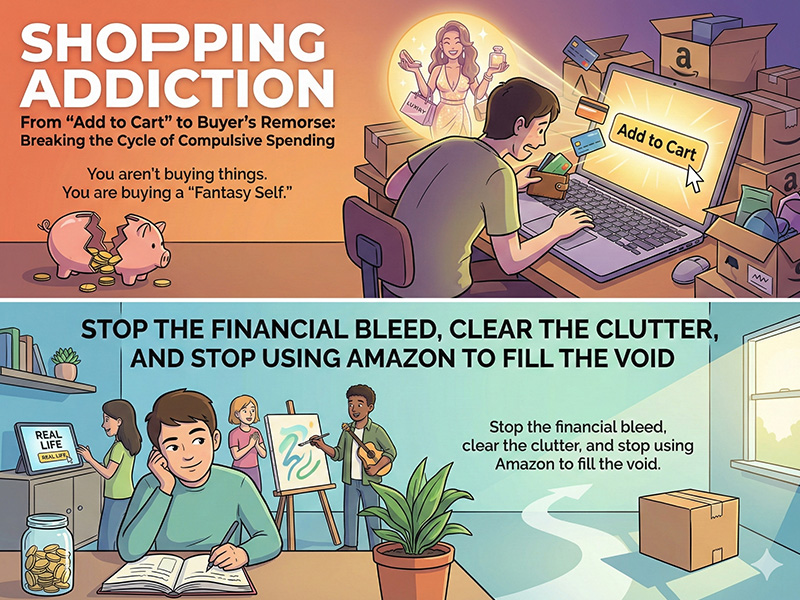
SHOPPING ADDICTION
From “Add to Cart” to Buyer’s Remorse: Breaking the Cycle of Compulsive Spending
You aren’t buying things. You are buying a “Fantasy Self.”
Stop the financial bleed, clear the clutter, and stop using Amazon to fill the void.
The “Anticipation” Trap: Why the Package Doesn’t Make You Happy
You spend hours researching the perfect gear. You obsess over specs. You feel a rush of adrenaline when you click “Buy Now.” You track the tracking number every hour. Then the box arrives. You open it. You feel a fleeting moment of satisfaction… and then, 20 minutes later, you feel empty again. So you start looking for the next thing.
This is the Dopamine Delivery Gap.
Neuroscience reveals that dopamine is the molecule of pursuit, not possession.
- The Hunt: Browsing, comparing, and hunting for deals spikes dopamine.
- The Click: The peak of the high.
- The Possession: Dopamine crashes. You have the object, but the chemical rush is gone.
You are addicted to the acquisition, not the item.
The Symptoms of “One-Click” Addiction
For men, shopping addiction often flies under the radar. It isn’t usually clothes; it’s Tech, Tools, Collections, and Gear.
1. The “Fantasy Self”
You don’t buy a camera; you buy the idea of being a photographer. You don’t buy a barbell; you buy the idea of being fit. This is Identity Purchasing. You are trying to buy a new personality instead of doing the work to build one. You have a garage full of expensive hobbies you haven’t touched in months.
2. The “Deal” High
“But it was 40% off!” If you spent $600 to save $400, you didn’t save anything. You spent $600. Marketing algorithms weaponize Scarcity (“Only 2 left!”) and Urgency (“Sale ends in 1 hour”) to bypass your logical brain. You aren’t making a financial decision; you are reacting to a manufactured crisis.
3. Financial Infidelity
You hide packages from your partner. You have a “secret” credit card. You rush home to intercept the delivery truck. When you start lying about where the money went, it is no longer a “hobby.” It is a pathology.
The Solution: Friction and Reality
Amazon, Apple Pay, and “Buy Now, Pay Later” (BNPL) services are designed to remove all Friction. They make spending money painless. Accountably puts the friction back.
1. The “Checkout” Intervention
Our Digital Phenotyping detects the “Shopping Binge” pattern—rapid browsing, multiple tabs, checkout page dwell time. The Intervention:
“I see you’re about to drop $200. Let’s pause. Calculate this in hours: You have to work 8 hours to pay for this item. Is it worth a full day of your life?”
2. The ROI Reality Check (Gemini-3 Powered)
Before you buy the “upgrade,” our Reasoning Engine checks your history.
“You bought the ‘Starter Kit’ for this hobby 3 months ago and haven’t used it. Why will the ‘Pro Version’ be different? Let’s use what we have first.” It challenges the “Fantasy Self” with the data of your “Real Self.”
3. The 72-Hour Rule
Impulse buys are emotional. Smart buys are logical. Accountably helps you enforce a Mandatory Cooling-Off Period. If you still want the item after 72 hours, you can buy it. 90% of the time, the urge (and the dopamine) will have vanished by then.
Privacy: Your Financial Secret
We know the shame of debt. We aren’t here to judge your bank statement.
- Financial Discretion: We don’t sell your purchase history to advertisers.
- No Bank Integration: We monitor the behavior (the app usage), not the bank account directly. Your financial credentials remain safe.
- Judgment-Free Zone: We help you fix the behavior so you can repair the finances.
Frequently Asked Questions
Q: Is collecting (sneakers, watches, cards) an addiction? A: It depends. Do you can afford it? Does it bring you long-term joy? Or are you spending rent money on “Grails” to feel a temporary rush of status? If the collection controls you (and your finances), it is a compulsion.
Q: What about “Retail Therapy”? A: “Retail Therapy” is a marketing term for Emotional Spending. It is using money to soothe anxiety or sadness. It works for about 20 minutes, and then the bill arrives, creating more anxiety. It is a negative feedback loop.
Q: How do I stop “Buy Now, Pay Later” (BNPL) traps? A: BNPL services decouple the pain of paying from the pleasure of buying. They are debt traps. Accountably encourages a “Cash Only” mindset for discretionary spending. If you can’t buy it twice, you can’t afford it.
Stop Filling the Void with Stuff.
You cannot buy your way to a better life. You have to build it. Clear the cart. Clear your mind.
© 2026 Accountably AI.