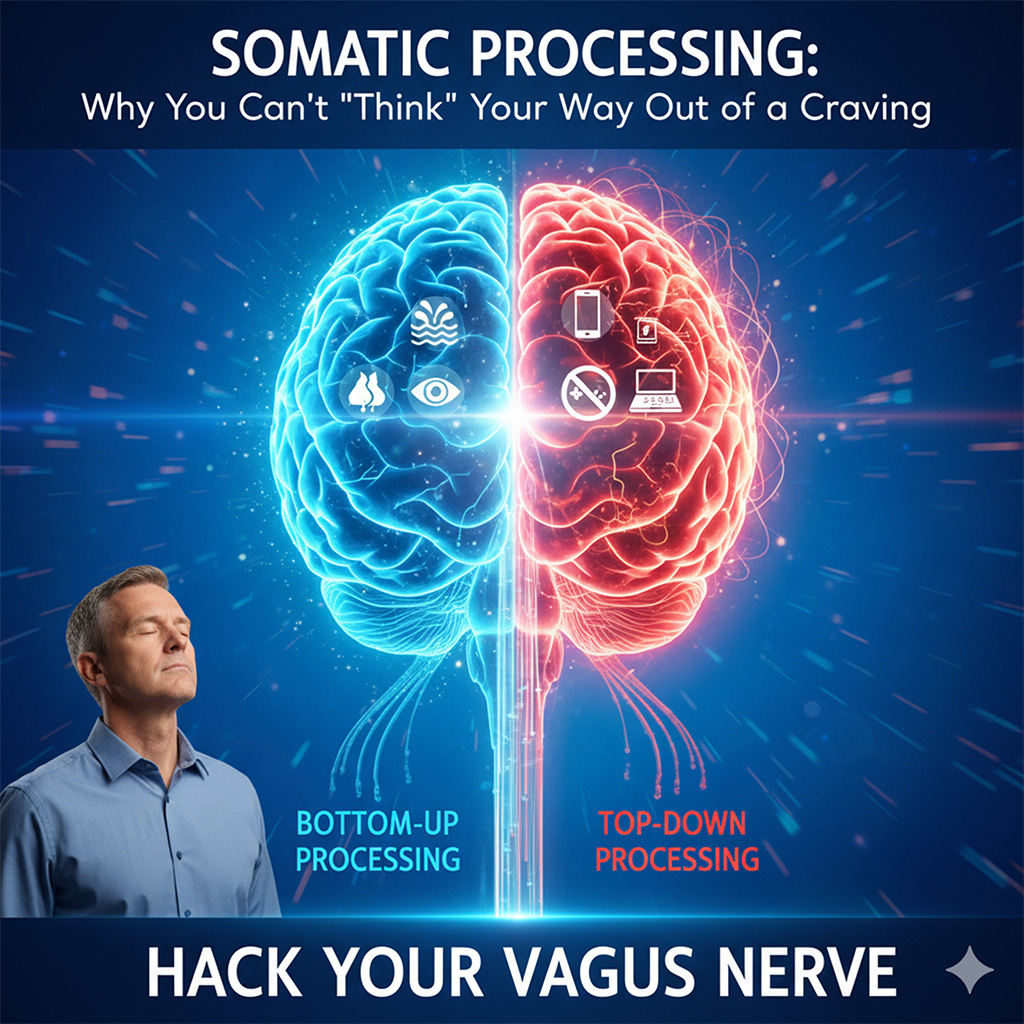
Standard advice tells you to “change your mindset” when an urge hits. But neuroscience shows that during a high-stress craving, your Prefrontal Cortex (logic centre) goes offline. You literally cannot “think” your way out because the thinking part of your brain is shut down. To survive the urge, you need “Bottom-Up Processing”—using the body to signal safety to the brain. Here is how to use Somatic Regulation to hack your Vagus Nerve and kill a craving in 90 seconds.
Explore
You know the feeling. A wave of anxiety or boredom hits. Your chest tightens—your heart rate spikes. A compulsion takes over: I need to scroll / game/watch.
You try to use logic: “Come on, you have a goal. Don’t do this.” But the logic feels like a whisper in a hurricane. You do it anyway. Then, 10 minutes later, the fog clears, and you think: “Why didn’t I just stop?”
The answer lies in the Polyvagal Theory.
When you are in a state of high arousal (Fight or Flight), your brain disconnects from the Prefrontal Cortex (Logic) and retreats to the Limbic System (Survival). In this state, “Top-Down” processing (using thoughts to calm the body) is biologically impossible. The phone line is cut.
You need “Bottom-Up” Processing. You must use the body to hack the brain.
Key Takeaways: The Body-First Protocol
- Top-Down vs. Bottom-Up: Top-Down is Mind->Body (ineffective during panic). Bottom-Up is Body->Mind (highly effective).
- The Vagus Nerve: The “Superhighway” connecting your brain to your gut and heart. Stimulating it triggers the “Brake Pedal” of the nervous system.
- The Freeze Response: Often, addiction isn’t about seeking pleasure; it’s about escaping a “Freeze” state (numbness/dissociation).
- State-Dependent Learning: You cannot access your logical tools (plans/goals) until you shift your physiological state.
The Neuroscience of the “Shut Down”
Why do we doomscroll? Often, it’s not because we are excited. It’s because we are stuck in a Dorsal Vagal State (Shutdown).
According to Dr Stephen Porges’ Polyvagal Theory, your nervous system has three gears:
- Ventral Vagal (Green): Safe, social, engaged. (The goal).
- Sympathetic (Red): Fight or Flight. Anxious, restless. (The trigger).
- Dorsal Vagal (Blue): Freeze. Numb, collapsed, dissociated. (The “Rot”).
When you are stuck in Sympathetic (Red) anxiety, you crave a dopamine hit to soothe the agitation. When you are stuck in Dorsal (Blue) numbness, you crave a dopamine hit just to feel something.
Your brain thinks the phone is the solution. But Somatic Tools are the actual solution.
3 Bio-Hacks to Reset the System
To bring the Prefrontal Cortex back online, you have to manually stimulate the Parasympathetic Nervous System (Rest and Digest).
1. The Physiological Sigh (The “Kill Switch”)
Discovered by neuroscientists, this is the fastest way to offload carbon dioxide and lower heart rate in real-time.
- The Protocol: Two sharp inhales through the nose (one big, one small to top it off). One long, extended exhale through the mouth.
- The Mechanism: The double inhale pops open collapsed alveoli in the lungs. The long exhale signals the Vagus Nerve to slow the heart.
- Rx: Do this 3 times. It takes 15 seconds. It works mechanically, even if you don’t “believe” in it.
2. The “Dive Reflex” (Cold Exposure)
If a craving is 10/10 intensity, you need a shock.
- The Protocol: Splash freezing cold water on your face (specifically the area under the eyes) or hold an ice cube in your hand until it hurts.
- The Mechanism: This triggers the Mammalian Dive Reflex. Your body thinks you are underwater and immediately slows your metabolism and heart rate to conserve oxygen. It physically forces a “System Reboot.”
3. Panoramic Vision (Optic Flow)
Screens lock us into “Focal Vision,” which increases alertness/stress.
- The Protocol: Look up. Soften your gaze. Try to see the walls on the far left and right of the room without moving your eyes.
- The Mechanism: Panoramic vision mechanically disengages the alertness centers in the brainstem. It signals “Safety” to the Amygdala.
Integrating Somatics into Accountably
Most accountability apps just yell at you. “Don’t do it!” Accountably reads your state.
When our Digital Phenotyping detects a high-stress signature (erratic typing, rapid switching), the AI Intervention isn’t a lecture. It’s a somatic command.
- “I detect high Sympathetic arousal. Let’s do 3 Physiological Sighs before we proceed.”
We don’t ask you to think. We ask you to breathe. Once the body is calm, the brain follows, and then we can talk about your goals.
Stop Fighting Your Biology
You cannot win a wrestling match against your own nervous system. If you are white-knuckling a craving, you are doing it wrong. Change the state of the body, and the mind will follow.
(Learn to drive your own nervous system.)
FAQ: Hacking the Nervous System
Q: What if I can’t catch my breath to do the sigh? A: That is normal in high panic. Start with Cold Water (Dive Reflex) first. The shock will force you to gasp (a deep inhale), which naturally resets your breathing rhythm. Then move to the Physiological Sigh.
Q: Do these techniques work for “Freeze” (bed rot) states? A: The Physiological Sigh is for anxiety (high energy). For “Freeze” (low energy), you need movement. Try shaking your hands vigorously or tense-and-release muscle progressions to wake up the nervous system.
Q: Is this “Woo-Woo” pseudoscience? A: No. The Vagus Nerve is a documented anatomical structure. Stimulating it has measurable effects on heart rate variability (HRV) and cortisol levels. This is mechanism, not magic.