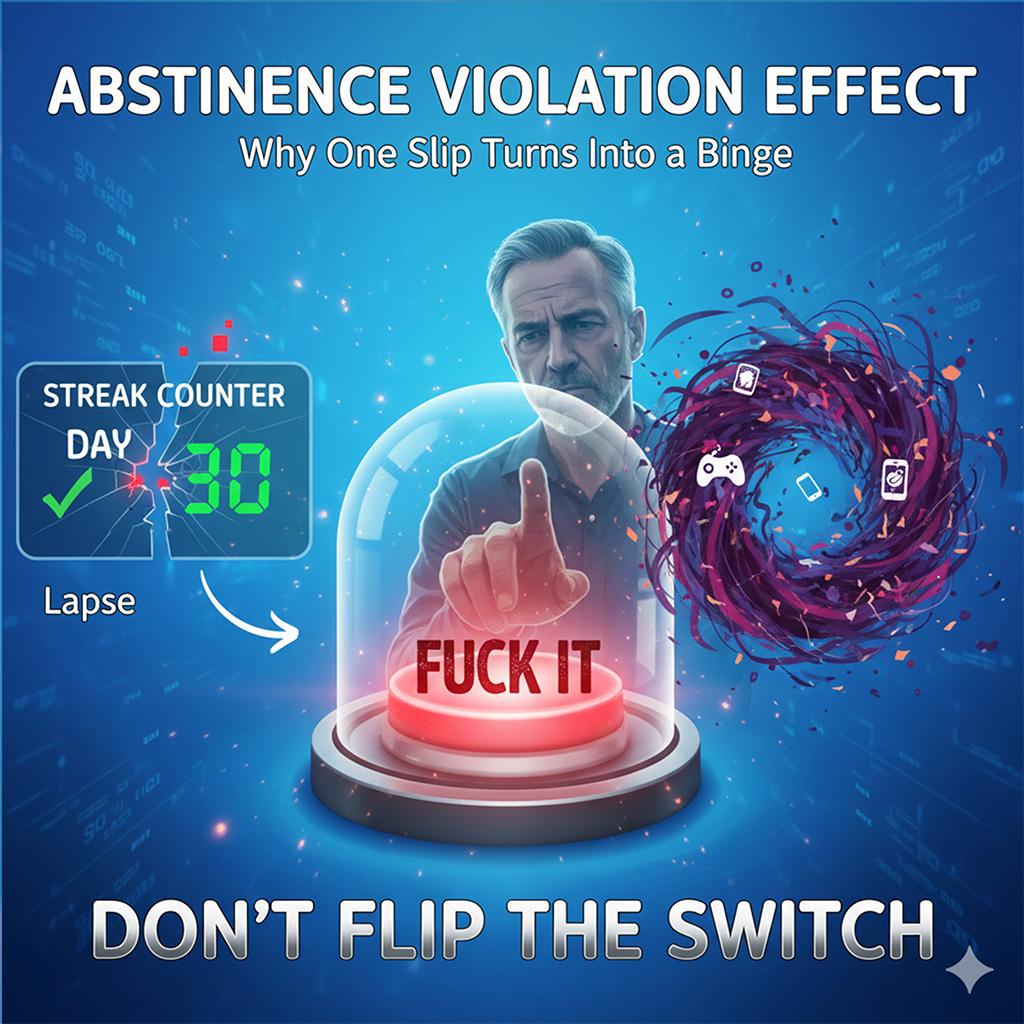
You promised yourself you wouldn’t game/scroll/watch porn. Then you slipped up for 10 minutes. Instead of stopping, you thought, “Well, I’ve already ruined the streak, I might as well go all in,” and proceeded to binge for 5 hours. This is not a lack of willpower. This is a specific cognitive bias called the “Abstinence Violation Effect” (AVE). It is the psychological mechanism that turns a minor “Lapse” into a catastrophic “Relapse.” Here is how to stop the “Fuck It” switch from flipping.
We have all been there. You are on a diet. You eat one doughnut. Logically, you should stop eating. One doughnut is 300 calories. It changes nothing. But emotionally, a switch flips. “I failed. The day is ruined. The diet is over.” So you eat the whole box.
In addiction recovery, this is lethal. A user on a 30-day NoFap streak peeks at an image. The streak is broken. The shame hits. And because the “perfect record” is gone, they binge for the next 48 hours to numb the pain of the failure.
This phenomenon has a name: The Abstinence Violation Effect (AVE).
It is the single biggest reason why “Streak-Based” recovery tools fail. They frame recovery as a house of cards—one slip, and the whole thing collapses.
Key Takeaways: The “Fuck It” Button
- Cognitive Dissonance: The mental stress caused when your actions (relapsing) contradict your self-image (“I am a recovering person”). Your brain resolves this tension by giving up on the self-image completely.
- Internal Attribution: The belief that a slip happened because you are weak/broken, rather than because of a specific trigger (tired/hungry). This fuels the shame spiral.
- Lapse vs. Relapse: A Lapse is a mistake. A Relapse is a return to the pattern. AVE turns the former into the latter.
- The Solution: You need “Emergency Brakes” for your brain, not a shame counter.
The Anatomy of the Spiral
Psychologists G. Alan Marlatt and Judith Gordon identified AVE in the 1980s. They found that the intensity of a binge depends on two things:
1. The “All-or-Nothing” Mindset
If you view recovery as binary (Success vs. Failure), you are setting yourself up for AVE. When the line is crossed, your brain perceives the loss as total.
- Healthy Mindset: “I slipped. I’m at 95% compliance this month.”
- AVE Mindset: “I’m back to zero. I’m a failure. I might as well enjoy the fall.”
2. The Shame Feedback Loop
After the slip, you feel guilt. Guilt is uncomfortable. To escape the discomfort of guilt, you seek… Dopamine. And where is the fastest source of dopamine? The addictive behavior you just did.
You binge to numb the shame of the binge. It is a perfect, self-sustaining hell.
Lapse vs. Relapse: The Critical Distinction
To beat AVE, you must change your vocabulary.
- A Lapse (The Slip): This is temporary. It’s a single event. You drank one beer. You watched one video. You lost $50. It’s a flat tire.
- A Relapse (The Collapse): This is a return to the lifestyle. You are drinking every day again. You are gaming 8 hours a night. This is slashing the other three tires because one went flat.
Accountably is designed to catch the Lapse. Most blockers just stop you before (Prevention). But what happens if you bypass them? We build tools for Damage Control.
How to Stop the Bleeding
You cannot prevent every slip. But you can prevent the spiral.
1. Externalize the Cause
When you slip, your inner critic screams: “You are weak.” (Internal Attribution). You need to shift to External Attribution: “I was exhausted, alone, and holding my phone. That was a high-risk setup. Next time, I won’t bring the phone to bed.” This moves you from “Shame” (I am bad) to “Strategy” (My plan was bad).
2. The “Emergency Brake” Protocol
In our Alpha testing, we are experimenting with a “Post-Lapse Protocol.” If the AI detects a slip (e.g., you disabled the blocker), it doesn’t shame you. It shifts gears.
- AI: “Okay, we had a lapse. The goal now is damage control. Can we stop within 10 minutes? If yes, that’s a victory.” It re-frames “stopping now” as a Win, breaking the AVE logic.
3. Kill the Streak
Stop counting days. Start counting Recovery Velocity. If you game 1 hour this week vs. 20 hours last week, you are winning. Don’t let a “Day 0” reset define your worth.
Resilience > Perfection
The goal of recovery is not to never fall. It is to reduce the time it takes to get back up. The Abstinence Violation Effect tries to keep you on the ground. Don’t let it.
(Build a recovery system that survives the bad days.)
FAQ: Managing a Slip
Q: Should I reset my counter if I slip for 5 minutes? A: We recommend not resetting to zero for a minor lapse. Resetting to zero often triggers AVE (“I lost everything, might as well binge”). Instead, log the lapse, analyze the trigger, and subtract it from your “Win Score,” but keep your cumulative progress intact.
Q: How do I stop the shame spiral? A: Externalize the cause. Instead of saying “I am weak,” say “I was tired and lonely.” Identify the HALT triggers (Hungry, Angry, Lonely, Tired). Analyzing the mechanics of the slip removes the moral judgment that fuels shame.
Q: Is “Harm Reduction” better than “Cold Turkey”? A: For many, yes. Focusing on reducing the frequency and duration of binges (Harm Reduction) reduces the pressure of perfectionism, which often lowers the risk of the Abstinence Violation Effect. Progress > Perfection.