Why Your “Dopamine Detox” Keeps Failing (And What Actually Works)
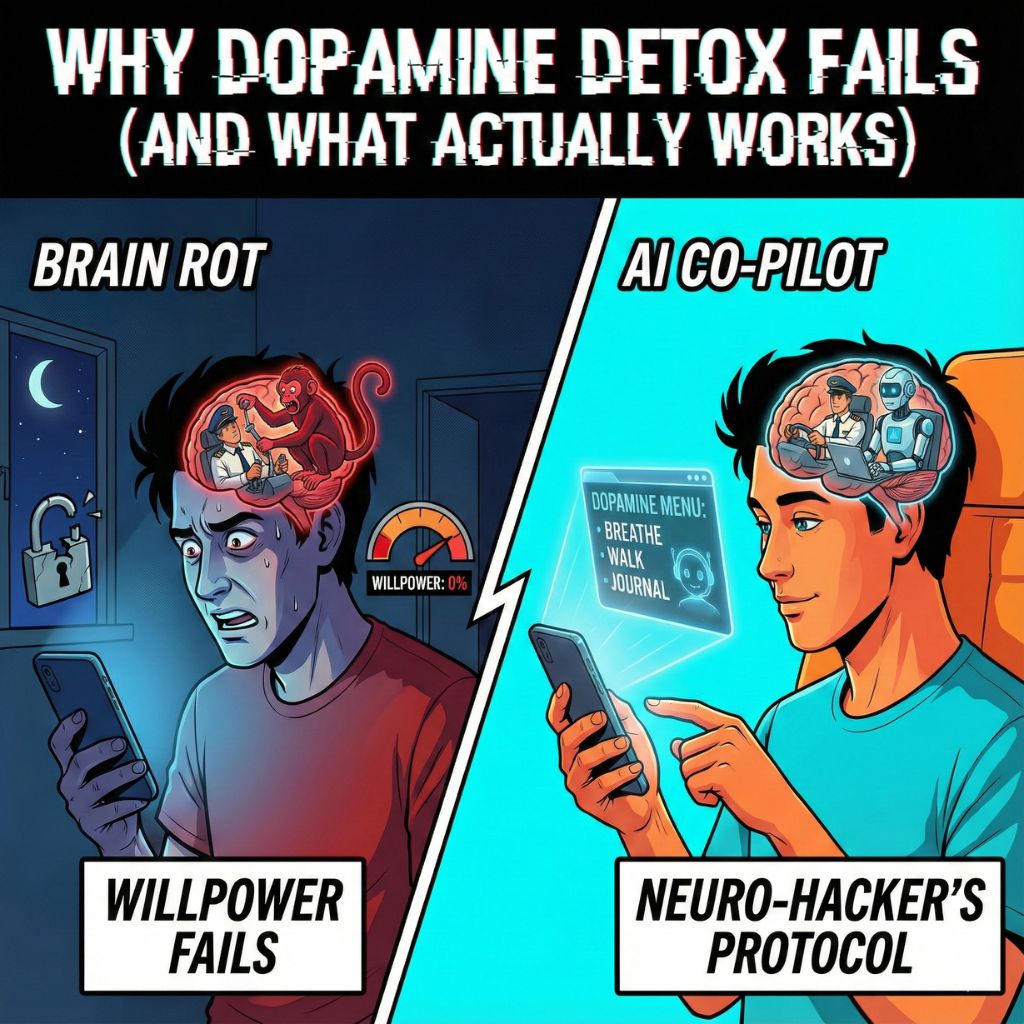
Stop trying to “white-knuckle” your recovery. Research shows that 95% of willpower-based attempts fail because they ignore the biological reality of Prefrontal Cortex Hypoactivity. You aren’t weak; your brain’s brakes are cut. The solution isn’t another strict “Monk Mode”—it’s Digital Phenotyping and Emotional Regulation. This guide explains how to move from “brute force” blocking to intelligent, data-driven recovery.
You are likely reading this at 2 AM, bathed in blue light, with a browser history you’d be terrified to show your mother.
You feel that familiar cocktail of emotions: the heavy fog of “Brain Rot,” the sharp pang of shame, and the desperate confusion of why. Why did you do it again? You promised yourself yesterday was the last time. You installed the blockers. You deleted the apps. You swore an oath.
And yet, here you are.
Let’s get real. The problem isn’t that you lack discipline. The problem is that you are bringing a knife to a nuclear war. You are fighting a trillion-dollar algorithmic army designed to hijack your ventral striatum (reward center) with a depleting resource called willpower.
It’s time to stop fighting harder and start fighting smarter.
Key Takeaways: The Neuro-Hacker’s Protocol
- Willpower is a Battery, Not a Trait: Relying on it is a guaranteed path to relapse. You need a system that works when your battery is at 0%.
- The “Cage” Doesn’t Work: “Dumb” blockers (Opal, Freedom) just create a prison you will eventually break out of.
- It’s Not About the App, It’s About the Feeling: Addiction is an emotional regulation failure, not a content problem.
- Predictive Accountability: The future of recovery is Digital Phenotyping—catching the urge before it becomes an action.
The Neuroscience of “Why I Can’t Stop”
You describe it as “Doomscrolling” or “Rotting.” Neuroscientists call it Prefrontal Cortex Hypoactivity.
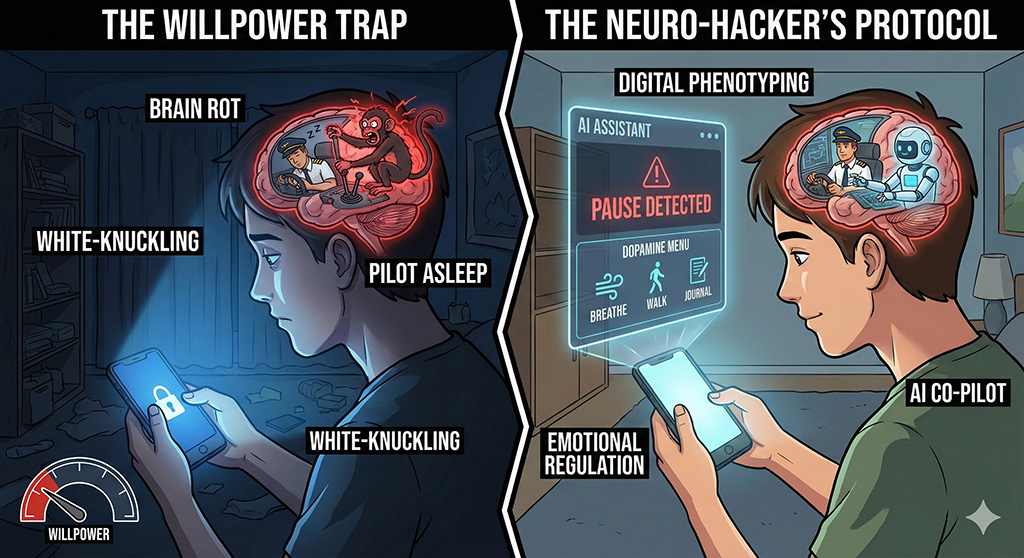
Your brain has two captains.
- The Pilot (Prefrontal Cortex): Responsible for long-term planning, impulse control, and “being a responsible adult.”
- The Chimp (Limbic System): Wants dopamine, sugar, and sex now.
When you are in a deep scroll hole or a “Gooning” trance, your Pilot is asleep at the wheel. The “Chimp” has completely hijacked the controls. This is why “just deciding to stop” feels impossible in the moment—the part of your brain responsible for “deciding” has effectively gone offline.
The “Dopamine Baseline” Crash
Every time you binge—whether it’s TikTok, porn, or gambling—you spike your dopamine. But what goes up must come down. The crash that follows drops you below your natural baseline.
This is the “Flatline.” You feel gray, empty, and anxious. To feel “normal” again, you reach for the phone. You aren’t scrolling for pleasure anymore; you are scrolling to survive the crash.
Why “Dumb” Blockers (and Willpower) Fail
Most of the advice you find on Reddit (r/NoFap, r/DigitalMinimalism) suggests two things:
- “Just Touch Grass”: Relying on sheer willpower (Monk Mode).
- The “Digital Cage”: Using apps like Freedom or Opal to brick your phone.
Here is why they fail:
- Bypassing is Easy: When the urge hits, an addict is the most creative engineer on the planet. You will find a way to disable the VPN, delete the profile, or find a browser that slips through the cracks.
- The “Forbidden Fruit” Effect: Psychological reactance means that simply banning something makes the urge 10x stronger.
- No Emotional Safety Valve: If you block the app but don’t address the anxiety that made you open it, your brain will just find another outlet (junk food, rage, spending).
You don’t need a cage. You need a Co-Pilot.
The Solution: Emotional Regulation & Intelligent Intervention
If we stop treating addiction as a “sin” and start treating it as a Pattern Recognition problem, the solution becomes clear.
1. Identify the “Cue” (Digital Phenotyping)
Before you relapse, your behavior changes.
- Typing Speed: Increases or becomes erratic.
- App Switching: You toggle rapidly between apps (hunting for dopamine).
- Time of Day: It’s 11:30 PM and your phone is horizontal.
This is called Digital Phenotyping. It is the digital footprint of your emotional state.
2. The Intervention (The “Pause”)
Imagine a tool that doesn’t just block you, but sees you. Instead of a cold “Access Denied” screen (which triggers rage), imagine an AI Interceptor that says:
“Hey. I notice you’re switching apps fast and it’s late. You usually do this when you’re feeling lonely or anxious. Do you want to take 2 minutes to breathe before we proceed?”
This breaks the “Amygdala Hijack.” It wakes up the Pilot. It forces the Prefrontal Cortex to come back online.
3. The “Dopamine Menu” (Replacement)
You cannot simply remove a habit; you must replace it. When the urge hits, you need a “Menu” of low-friction options:
- Appetizers (2 mins): Physiological Sigh (Double inhale, long exhale), drink a glass of water, do 5 pushups.
- Main Course (15 mins): Silent Walking (no podcasts), journaling, reading fiction.
- Dessert (1 hour): Gym, deep work, cooking.
FAQ: The Recovery Reality Check
Q: Is “Brain Rot” permanent? A: No. Your brain is neuroplastic. Research shows that dopamine receptors can regenerate, and gray matter density can improve within 8-12 weeks of reduced stimulation. You can heal.
Q: What is the “Chaser Effect”? A: This occurs shortly after a relapse (or sexual activity) where cravings spike massively for 24-48 hours. It is a critical danger zone. Awareness is your best defense.
Q: Does “Monk Mode” (quitting everything at once) work? A: Rarely long-term. It usually leads to a “binge-purge” cycle. Sustainable recovery is about building systems, not relying on bursts of motivation.
Q: Why do I feel “Flat” (Anhedonia) when I quit? A: This is withdrawal. Your brain is recalibrating its sensitivity to pleasure. It is a sign that healing is happening. Embrace the boredom; it is the fertilizer for focus.
Q: Can AI really help with intimacy and isolation? A: AI isn’t a replacement for human connection, but it’s a bridge. Shame thrives in secrecy. An AI Coach provides a judgment-free zone to practice vulnerability, building the “social muscle” you need to reconnect with real people.
The Next Step: Don’t Walk Alone
You have analyzed the problem. You understand the neuroscience. But information alone doesn’t change behavior—Accountability does.
We are building the first AI Accountability Coach designed to understand your biology, not just block your browser. It uses Digital Phenotyping to spot the urge before you slip, and offers the compassionate, firm support you need to rewire your brain.