Variable Reward Schedules: Why You Can’t Stop “Pulling the Lever”
Why is gambling addictive but a monthly paycheck isn’t? Because of “Uncertainty.” In the 1950s, B.F. Skinner discovered that if you give a rat a treat every time it presses a lever, it gets bored. But if you give it a treat randomly (50% of the time), the rat will press the lever until it dies of exhaustion. This is a “Variable Reward Schedule.” It is the exact psychological weapon used by TikTok, Tinder, and Gacha Games to keep you doomscrolling at 3 AM.
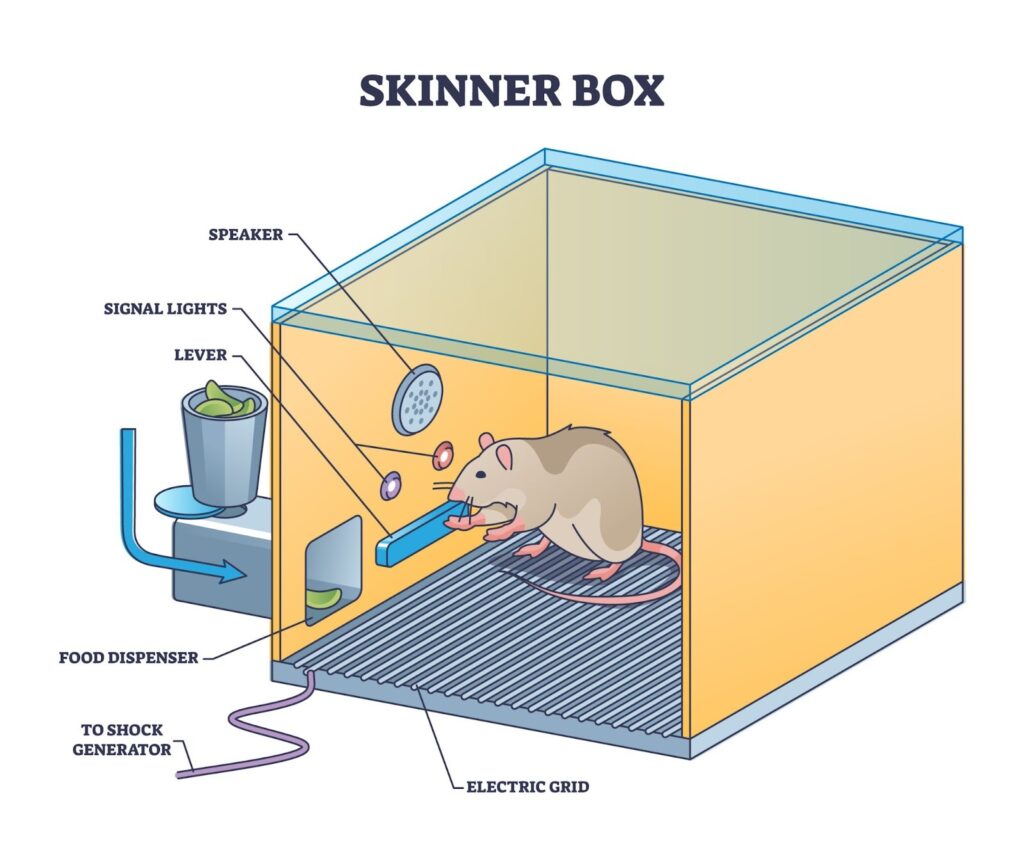
You think you are addicted to the content. You aren’t. You are addicted to the hunt.
If you opened TikTok and every single video was a 10/10 banger, you would actually get bored and close the app after 20 minutes. If you played a slot machine and won $1 every single spin, you would walk away.
The reason you can’t stop is because most of the content is trash.
- Video 1: Boring ad.
- Video 2: Cringe dance.
- Video 3: DOPAMINE HIT. (Funny cat / Attractive person / Shocking news).
That mixture of “Trash, Trash, Trash, GOLD” is what neuroscientists call Intermittent Reinforcement. It is the most powerful way to condition a brain to repeat a behavior, and it is the foundation of the modern attention economy.
Key Takeaways: The Architecture of Addiction
- The Skinner Box: The psychological experiment that proved “Maybe” is more addictive than “Yes.”
- Reward Prediction Error: Dopamine doesn’t spike when you get the reward; it spikes when you anticipate a reward that is uncertain.
- The “Pull-to-Refresh”: This UI gesture was explicitly designed to mimic a slot machine lever.
- Breaking the Spell: You cannot rely on willpower against a Variable Ratio Schedule. You must remove the lever.
The Neuroscience of “Maybe”
Your brain is a prediction engine. Its primary job is to predict what happens next.
When a pattern is predictable (e.g., “If I push this button, I get food”), your brain automates it. It stops releasing dopamine because there is no new information. It becomes a chore.
But when the outcome is unpredictable, your Mesolimbic Pathway goes haywire. When you pull the lever (or refresh the feed), your brain screams: “IS THIS THE ONE?”
This triggers a massive spike in Reward Prediction Error.
- Scenario A (Fixed Reward): You know you will win. Dopamine = Low.
- Scenario B (Variable Reward): You might win. Dopamine = 400% Higher.
This biological mechanism was designed to help us hunt for food in the wild. Today, it keeps you trapped in a Gacha Game or refreshing your Ex’s Instagram profile to see if they posted.
The Digital Skinner Box
Silicon Valley didn’t invent this; they just industrialized it. Every major app on your phone is a Skinner Box in disguise.
1. The “Feed” (TikTok / Reels / Shorts)
The algorithm is tuned to give you just enough “duds” (boring videos) to keep you hungry for the “hit.” If the feed was too good, you’d be satisfied. They need you unsatisfied. They need you chasing the dragon.
2. Dating Apps (Tinder / Hinge)
The “Swipe” is a Variable Ratio lever.
- Left (No Reward).
- Left (No Reward).
- MATCH (Big Dopamine). This transforms the search for human connection into a slot machine mechanic. You aren’t looking for love; you are looking for the “Match” notification.
3. Loot Boxes & Gacha
In gaming, you don’t buy the sword. You buy a chance to get the sword. The lights flash. The box spins. The anticipation builds. This utilizes the “Near Miss” Effect. When you almost win the rare item, your brain releases almost as much dopamine as if you actually won. It tricks you into thinking, “I’m close! Just one more spin.”
How to Escape the Cage
Understanding the Variable Reward Schedule is the first step to breaking it. You realize that the “boring” parts of the feed aren’t mistakes—they are part of the trap.
Accountably is designed to interrupt the lever-pulling mechanism.
1. The Pattern Interrupt
When our Digital Phenotyping detects the “Rapid Scroll” or “Refresh Spam” behavior, we know you are in a Skinner Loop. We intervene. “You have refreshed this feed 15 times in 60 seconds. You are hunting. Pause.”
2. De-Gamifying the Experience
We guide you to turn off the sensory triggers that fuel the loop.
- Grayscale Mode: Removes the colorful reward signals.
- Notifications Off: Stops the external “cues” that pull you back in.
3. Fixed Reward Replacement
We encourage replacing “Variable Rewards” (scrolling) with “Fixed Rewards” (reading a chapter, doing a workout). Fixed rewards are less addictive, but they are deeply satisfying. They rebuild your Baseline Dopamine.
FAQ: Breaking the Loop
Q: Why do I feel anxious when I can’t check my phone? A: That is Withdrawal. Your brain has been conditioned to expect the variable reward. When you remove the lever, the brain panics because the prediction loop is broken. This anxiety fades within 7-14 days.
Q: Are all variable rewards bad? A: No. A surprise party is a variable reward. A random compliment is nice. The problem is high-frequency variable rewards delivered by an algorithm designed to monetize your attention.
Q: Can I just limit my time? A: Time limits rarely work against Variable Schedules because the urge to check “just once” is too strong. You usually need a period of total abstinence (Detox) to break the conditioning.
Stop Being the Rat
You are a human being with free will, not a lab rat pressing a lever for a pellet. Recognize the game. See the cage. Walk out.
(We help you break the lever.)